

Close Menu
DPC Virtual Tips
    Read More

    How to Troubleshoot Packet Drops on an ESXi Host

    August 16, 2026

    SlurmDBD Is Down: What Continues Working and What Does Not

    August 15, 2026

    How to Investigate Jobs Stuck in COMPLETING State on Slurm

    August 14, 2026
    • Home
    • About Us
    • Contact
    • Cookie Policy
    • Comment Policy
    • Privacy Policy
    • Terms of Use
    • Disclaimer
    Tuesday, August 25
    DPC Virtual Tips
    • Home
    • Operating Systems
    • PowerFlex
    • HPC
    • Virtualization
    • About the Author
    • About Us
    • Contact
    DPC Virtual Tips
    Home » Collecting Support Bundle on the NSX Environment
    Virtualization

    Collecting Support Bundle on the NSX Environment

    DaniloBy DaniloJanuary 17, 2024Updated:July 30, 2026No Comments3 Mins Read
    Facebook Twitter Pinterest LinkedIn Tumblr Email
    NSX support bundle
    Share
    Facebook Twitter LinkedIn Pinterest Email

    Collecting Support Bundle on the NSX Environment is an article that explains how to generate a bundle of log components present in the NSX architecture.

    For some people, this task can be straightforward, but for others can be difficult mainly when the people have not done it before. So, our aim here is just to provide all the necessary steps to create the log bundle for all components present in the NSX.

    First and foremost, what is the reason or purpose for generating a support bundle?

    Generating a support bundle is a useful task when we need to engage VMware support or a specialized team to help us. In this case, for instance, if you need to engage the VMware Global Support Team, they probably will ask you to collect and upload the support bundle – and of course, they will ask you for more details of your issue, when the issue started (timestamp), if the issue is reproducible, and so on.

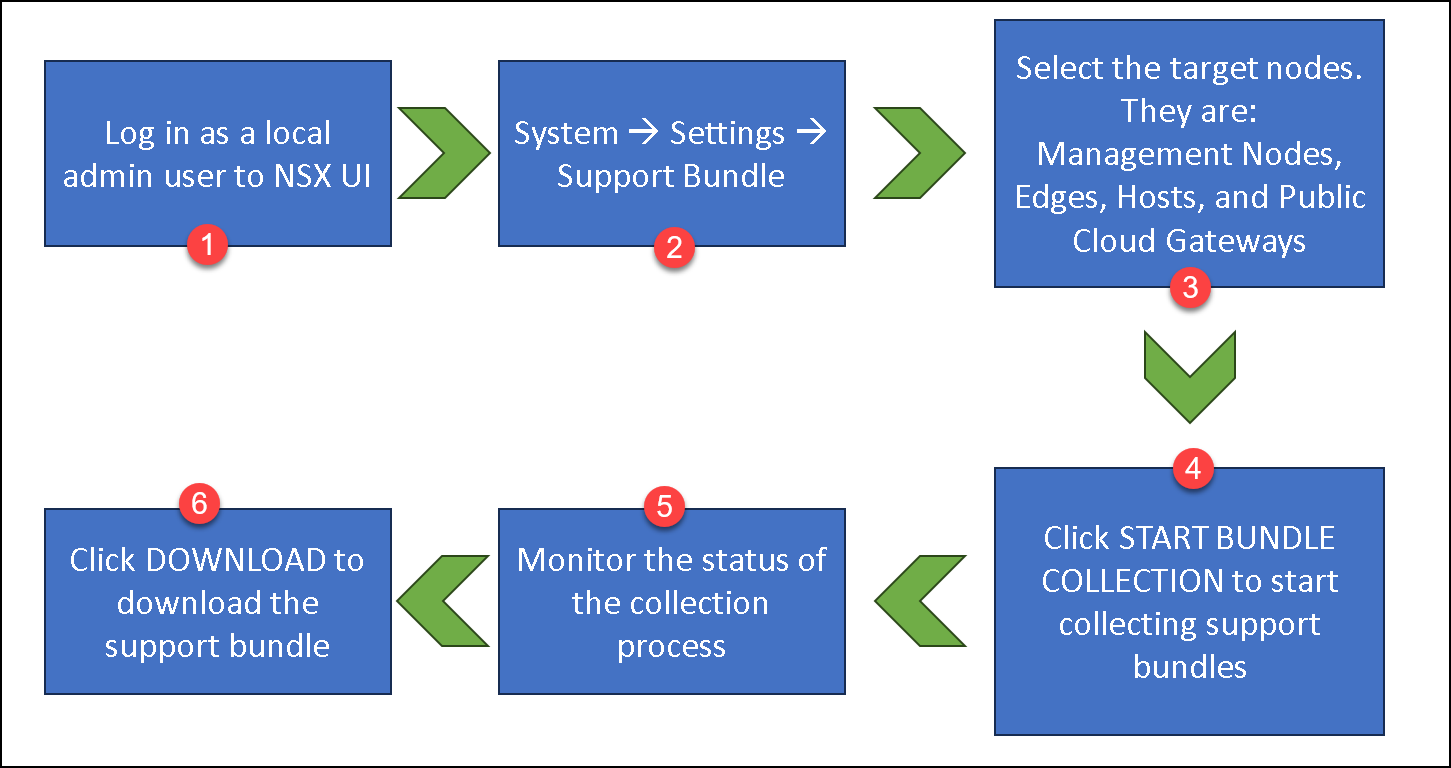
    We can see the basic support bundle collection flow in the picture below:
    Let’s Get Started

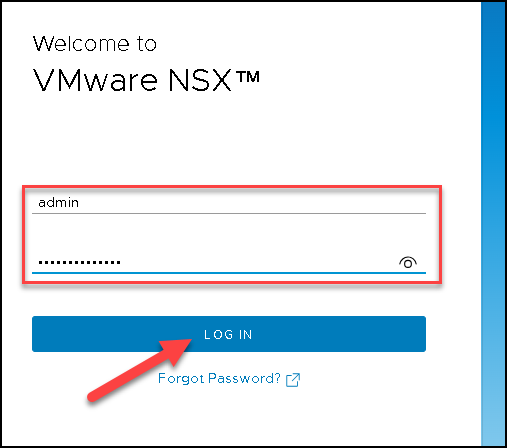
    Firstly, we need to access the NSX Manager UI. Log in with a user with admin rights. In this case, for instance, we are using the “admin” user:
    Go to System –> Settings –> Support Bundle –> Request Bundle

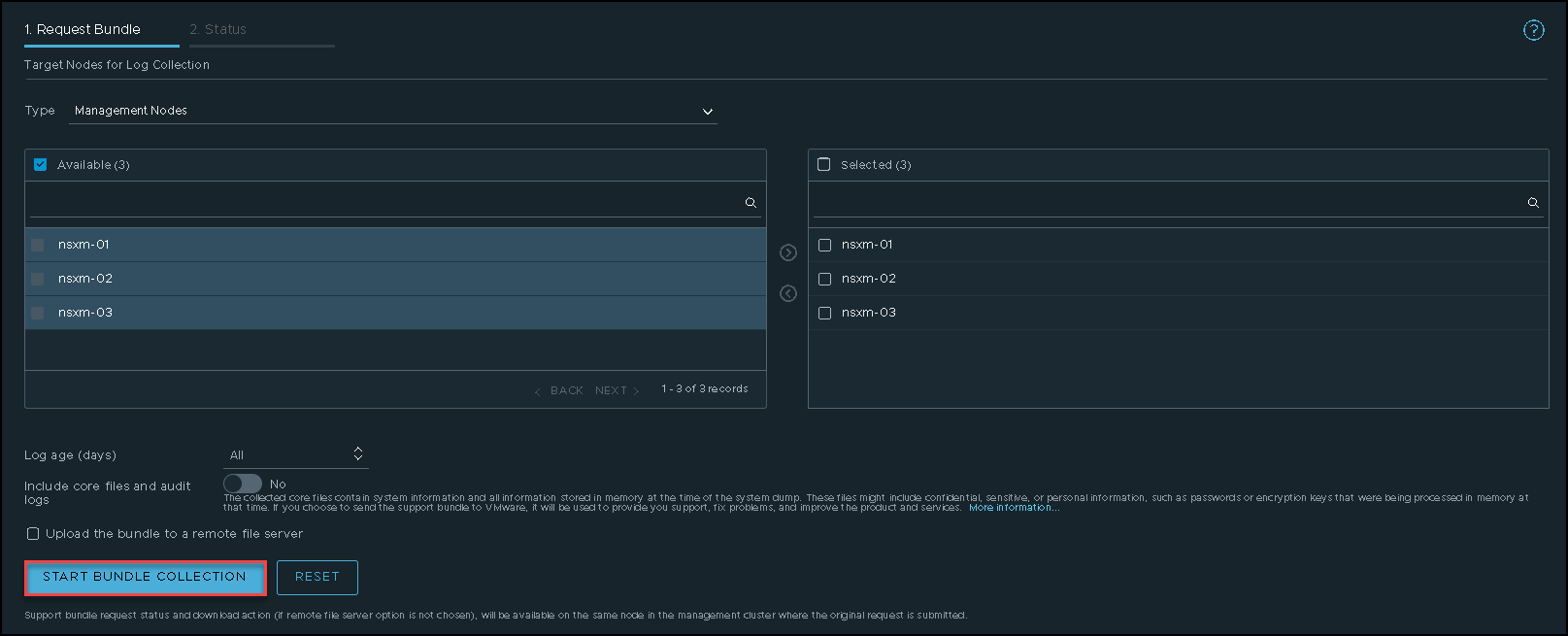
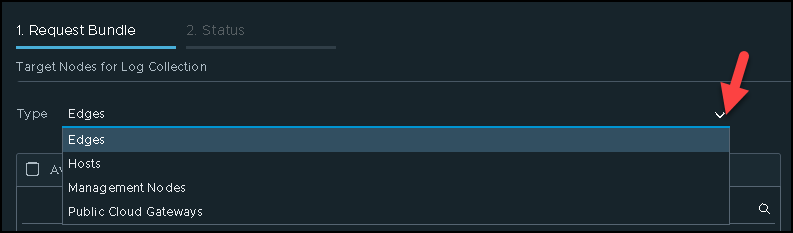
    Under “type”, we can select what component to export the logs. By default, the selected component is the “Management Nodes”:
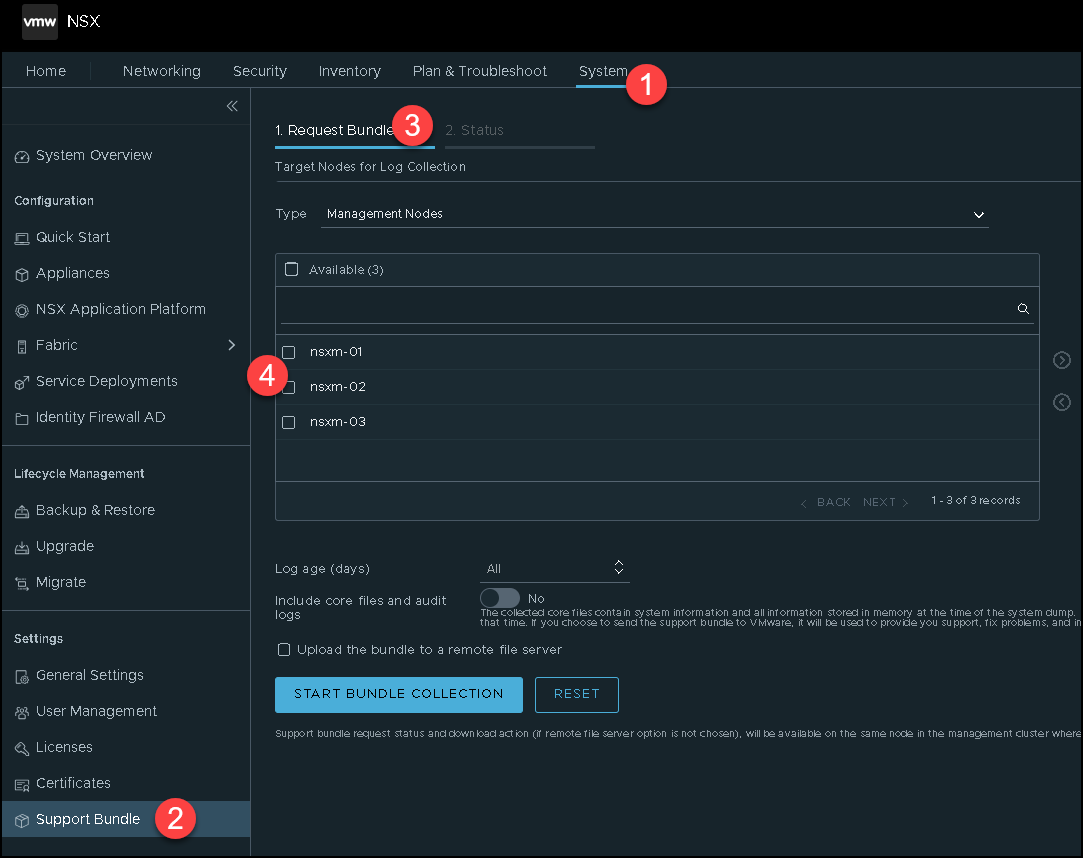
    In our lab, we have three (3) NSX Manager Appliances. We can select only one or select all NSX Manager Appliances available.
    We selected all NSX Manager Appliances available, as we can see in the picture below:
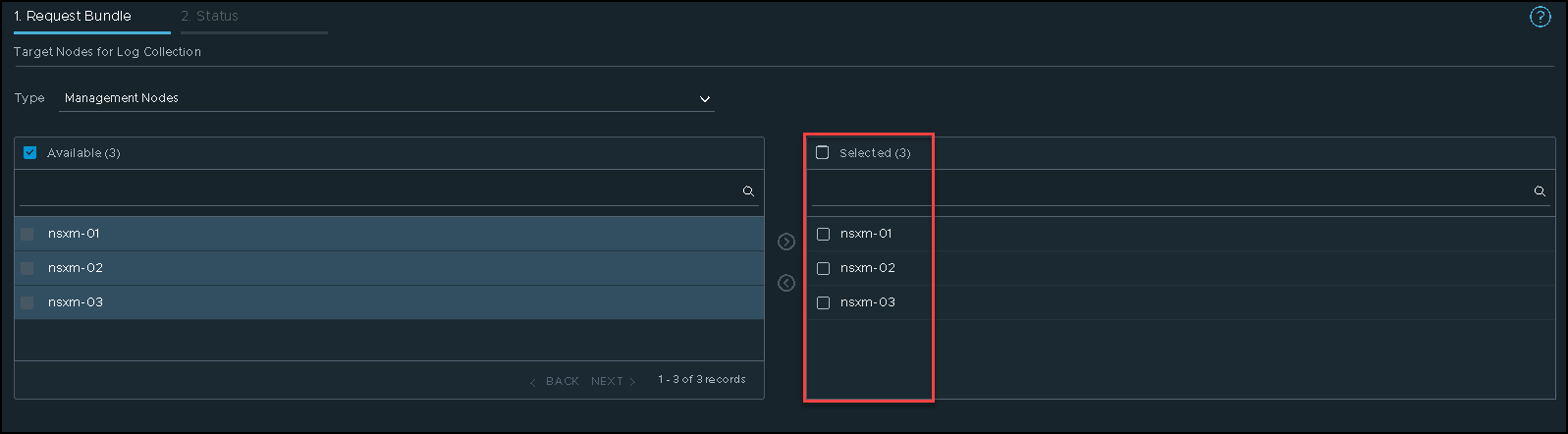
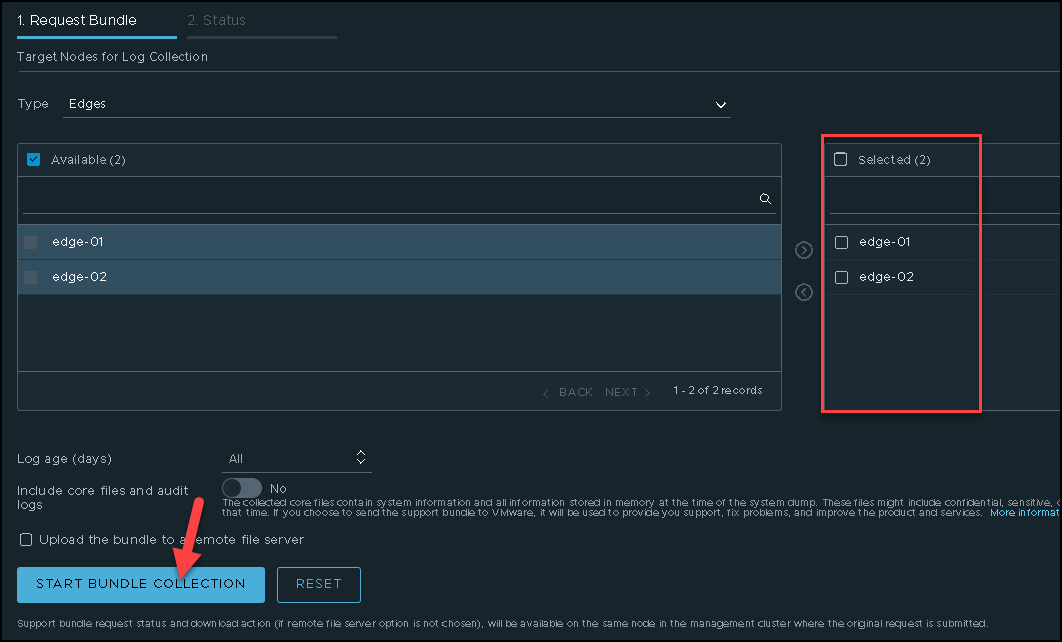
    After that, we can see under “Selected” all NSX Manager Appliances.
    Click on “START BUNDLE COLLECTION” to start the support bundle collection process:
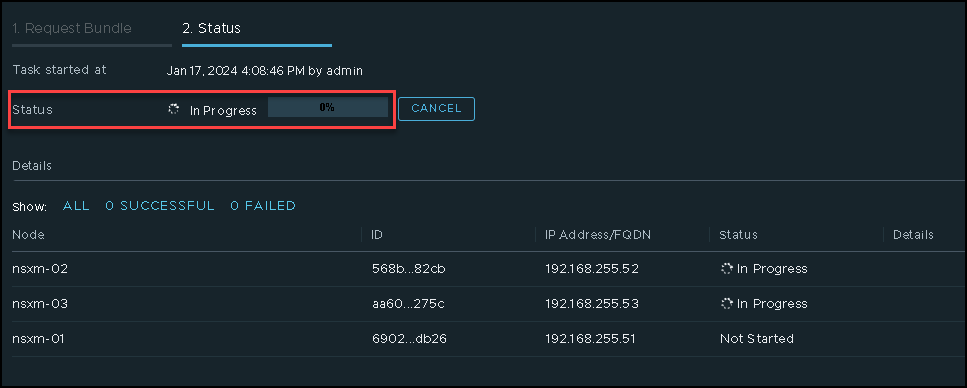
    This process needs a lot of time to finish (in a lab environment, with lower resources, it is normal to need more time than normal to finish this task). So, take a cup of coffee and wait 🙂
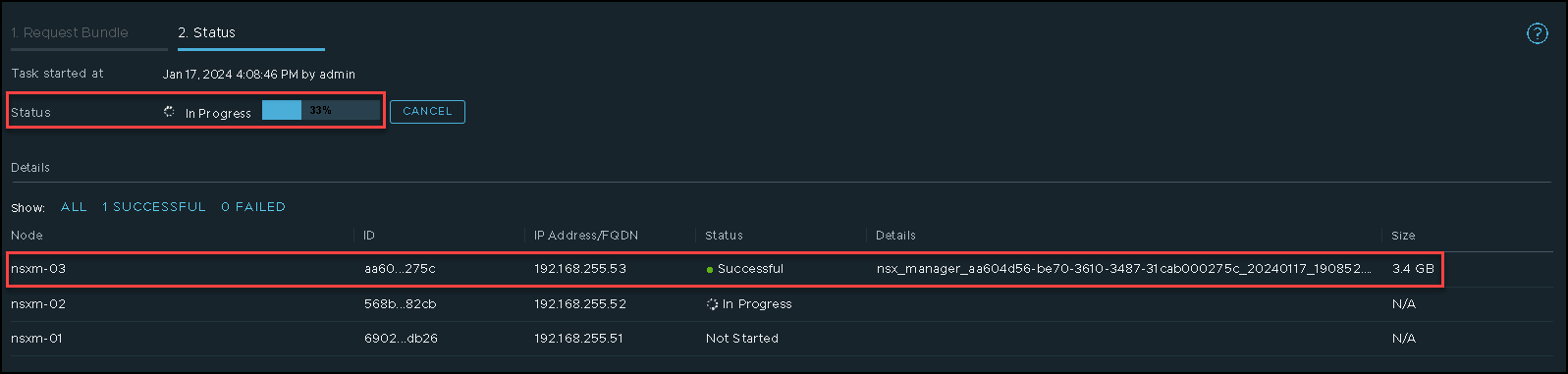
    As we can see in the picture below, the support bundle for the NSX Manager Appliance “nsxm-03” finished:
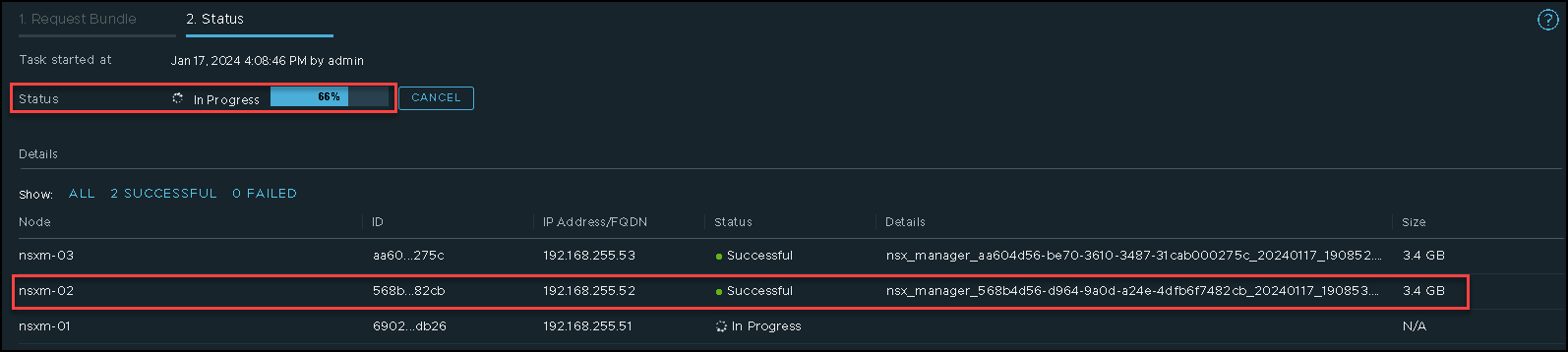
    The same occurred for the NSX Manager Appliance “nsxm-02”:
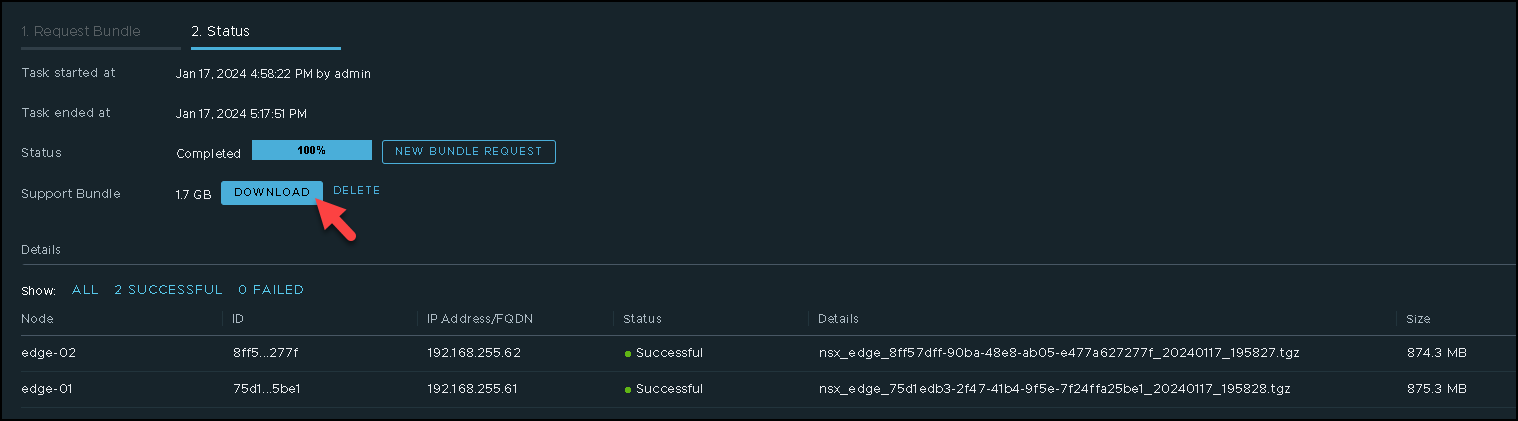
    In the picture below, we can see that the collection process was finished.
    Now, we need to click on “DOWNLOAD” just to download the support bundle file:
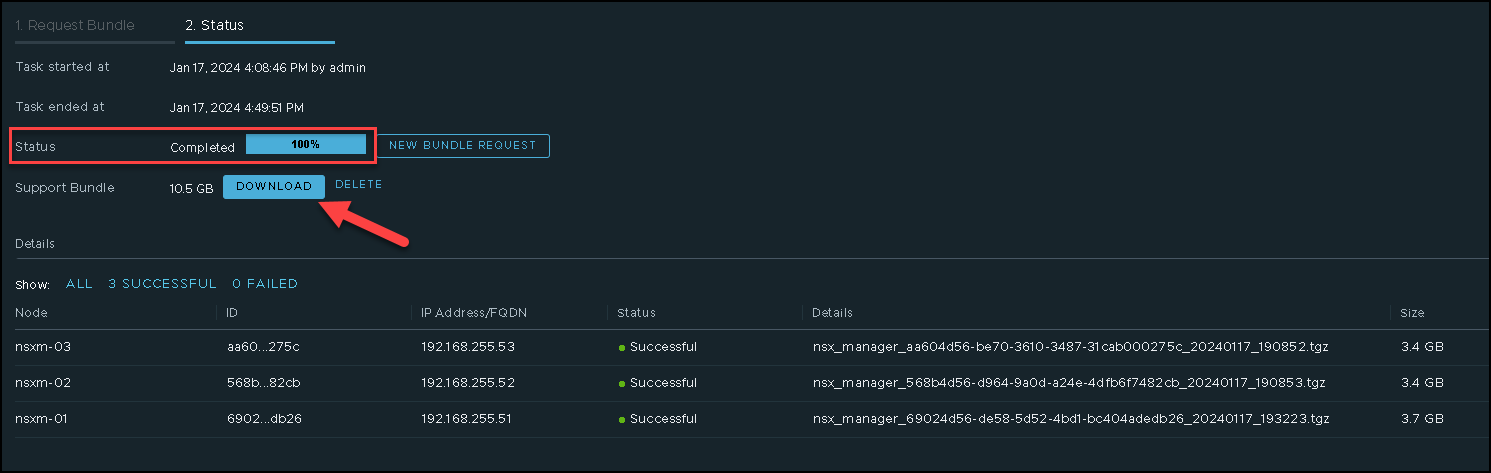
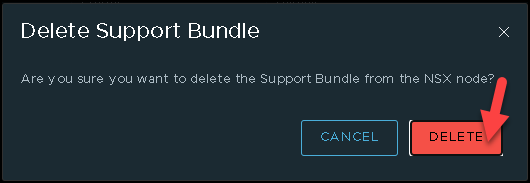
    After downloading the support bundle, we can delete it by clicking on “DELETE”:
    We can use the same process to generate the support bundle logs for other components:
    To generate a support bundle for Edge Nodes, select the “Edges” under type and follow the same process:
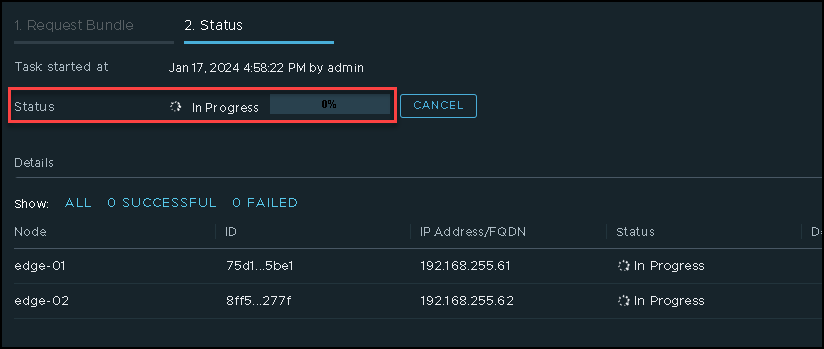
    Waiting for the log collection to be finished and download it:
    That’s it 🙂

    To get more details, I highly recommend you to visit the docs.vmware.com:

    • https://docs.vmware.com/en/VMware-NSX/4.1/nsx-application-platform/GUID-50FB1A3F-07D8-4125-9252-DB05C28BE7E1.html

    Share. Facebook Twitter Pinterest LinkedIn Tumblr Email
    Previous ArticleInstalling Docker Compose on CentOS
    Next Article Installing a VMware Aria Operation for Logs Content Pack for NSX
    Danilo

    Infrastructure Engineer with experience in Virtualization, Linux, Windows Server and learning automation using Python. DPC Virtual Tips was created to share practical tutorials, lab experiences and troubleshooting guides focused on enterprise infrastructure technologies.

    Related Posts

    How to Troubleshoot Packet Drops on an ESXi Host

    August 16, 2026

    VM Replication with vSphere Replication and Site Recovery Manager

    June 16, 2025

    Changing DNS Settings on ESXi Hosts

    May 20, 2025

    Comments are closed.

    Search
    Categories
    • HPC (12)
    • Operating Systems (85)
    • PowerFlex (22)
    • Virtualization (130)
    Read More
    Virtualization

    How to Troubleshoot Packet Drops on an ESXi Host

    By DaniloAugust 16, 20260
    HPC

    SlurmDBD Is Down: What Continues Working and What Does Not

    By DaniloAugust 15, 20260
    HPC

    How to Investigate Jobs Stuck in COMPLETING State on Slurm

    By DaniloAugust 14, 20260
    Operating Systems

    Linux Server Has Free Memory but Is Swapping: Why?

    By DaniloAugust 13, 20260
    Operating Systems

    How to Determine Whether Packet Loss Is Local or Network Related on Linux

    By DaniloAugust 12, 20260
    Latest Posts

    How to Troubleshoot Packet Drops on an ESXi Host

    August 16, 2026

    SlurmDBD Is Down: What Continues Working and What Does Not

    August 15, 2026

    How to Investigate Jobs Stuck in COMPLETING State on Slurm

    August 14, 2026
    Images from Gallery
    hpc main commands
    linux commands
    install rock linux
    lustre fs
    shell scripting
    vSAN Trace Files
    Categories
    • HPC
    • Operating Systems
    • PowerFlex
    • Virtualization
    • Home
    • About Us
    • Contact
    • Cookie Policy
    • Comment Policy
    • Privacy Policy
    • Terms of Use
    • Disclaimer
    Copyright © 2026, DPC Virtual Tips. All rights reserved.

    Type above and press Enter to search. Press Esc to cancel.

    We use cookies to ensure your best experience on our website. If you continue using our website, we'll assume you agree to our cookie policy